
September marked COASST species number 224 as Charlie (COASST bird verifier extraordinaire) verified a Hawaiian Petrel found by Laura G. in April 2026 on her COASST survey of Gearhart Beach near Seaside, Oregon. Known as ‘Ua‘u (oo-AH-oo) in Hawaiian, these rare, endemic (native and geographically restricted) birds are named after the eerie sounds the adults make in their burrow nests at night.
It’s easy to tell this bird is a tubenose from the encased nostrils (tube) along the upper part of their short black beak. Related to fulmars and shearwaters, Hawaiian Petrels have sooty-dark upperparts (cap, nape, wings, back and tail) and snowy white underparts (chin, throat, breast, belly, undertail and underwing linings, with a black bar or stripe extending from the wrist towards the body). The white bleeds up above the bill to the cheeks and forehead and pink feet with variably black toes complete the picture.
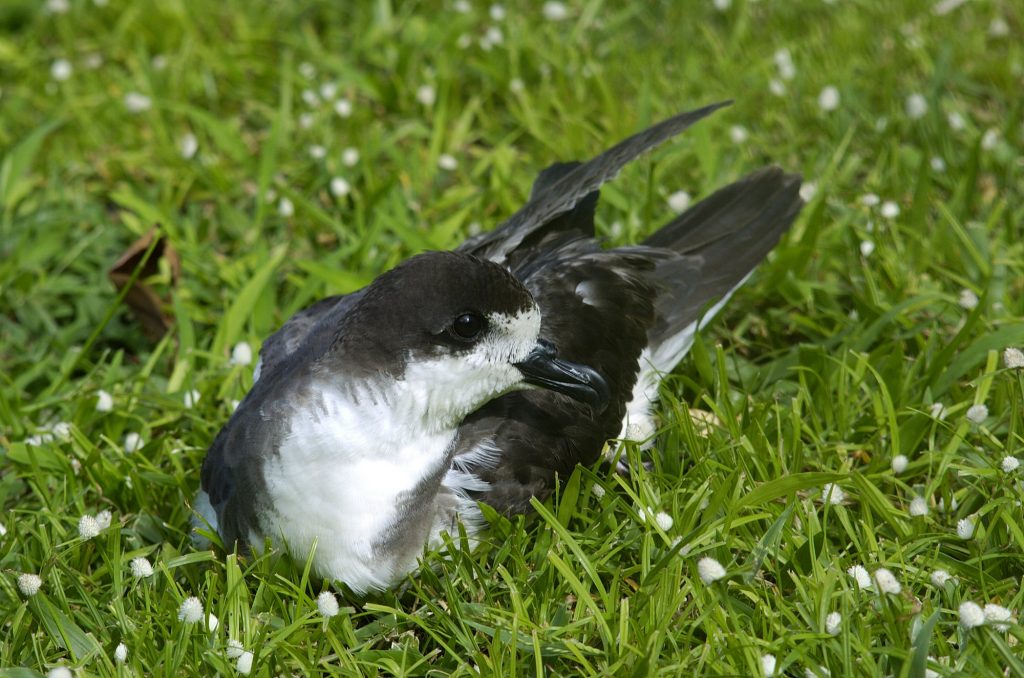
Their long, slender wings are made for soaring, and this bird certainly gets around on them. Hawaiian Petrels can fly thousands of kilometers from their mid-ocean nesting colonies to search for squid, krill and small fish to eat.
Listed as endangered by the IUCN and under the Endangered Species Act in the U.S., this species nests on the Hawaiian Islands and is principally found on the top of Haleakalā, the dormant volcano on the island of Maui. With a world population of only 10,000-20,000 individuals, and an open ocean home range far from the coastal shelf, Charlie was certainly surprised to see the ‘ua’u in Laura’s photos.
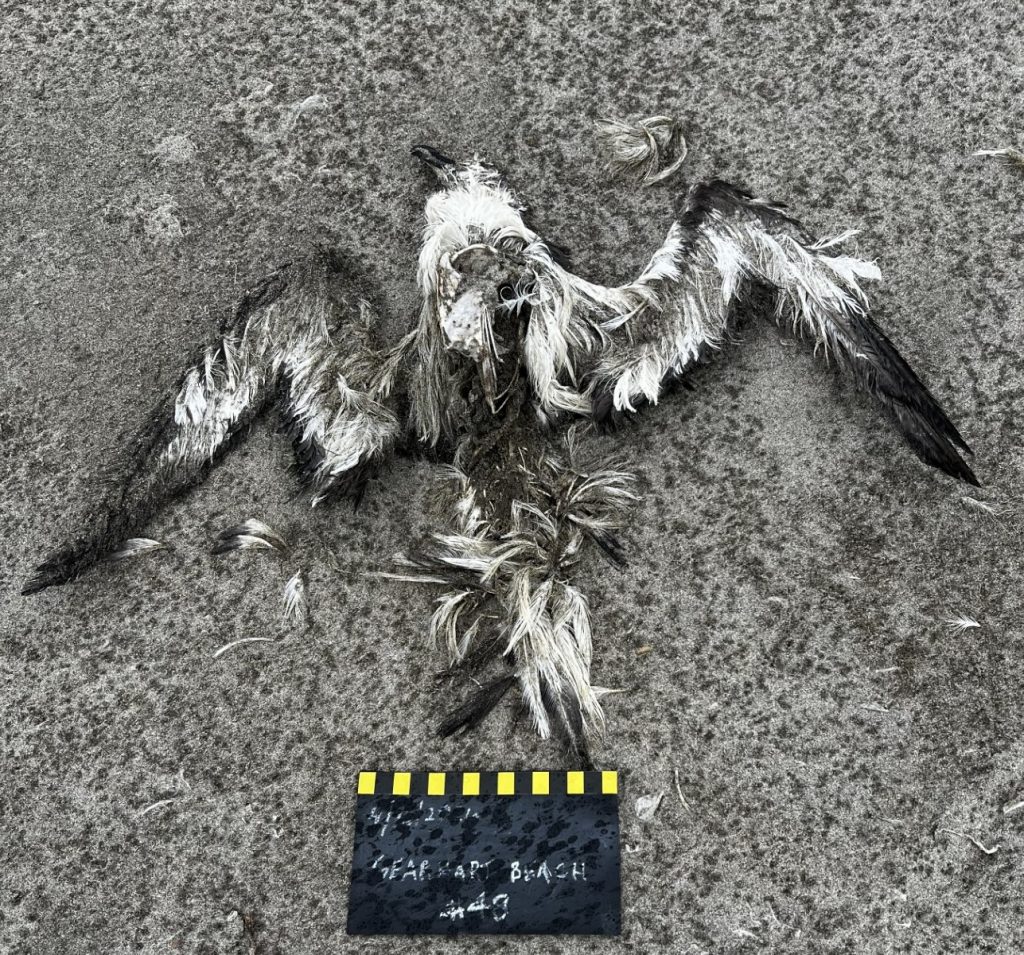
Because this species is not in our field guide, Laura identified it as a Sooty Shearwater, taking back and belly photos just as it began to rain. Charlie was struck by the picture of the bird’s underside, including the extensive white underwings with a black bar extending from wrist towards elbow. Bingo! Without that underside photo this bird would likely live in the COASST database as “unknown gadfly petrel.”
What was a Hawaiian Petrel doing off the coast of Oregon? During nesting, it takes both parents to raise their single chick. Birds return every year by March to reunite with their mate and get set for another long rearing season. The egg hatches in July and chicks don’t fledge until October-November, so perhaps this bird wasn’t a breeder.
COASST work with oceanographer Parker McCready and his LiveOcean model indicates that any bird carcass more than 100 kilometers from the coast will never make it to shore. Instead, it will sink or be scavenged long before it has the chance to arrive. This bird was far away from its usual open ocean ambit. The individual in question had a broken nasal tube and a damaged skull, perhaps a raptor kill? Regardless, this bird was way off course!
There have been live Hawaiian Petrels found along the West Coast over the years, mainly observed by offshore of California and Oregon. Records farther north are scarcer, although the non-breeding range of the species extends from the shelf-slope of North America up to the Gulf of Alaska, and clear across to Taiwan, the Philippines and Papua New Guinea. This year, with warmer than normal waters as a mammoth El Niño continues to brew and creep up our coast, ‘ua‘u seemed to come closer in. Sightings include a beautifully photographed bird on Cordell Bank near San Francisco, California (June), an unphotographed sighting off Westport, Washington (June), and two more birds reported off British Columbia in July and August.
Perhaps the bird discovered on Gearhart Beach was lured into our coastal shelf environment in search of food, as foraging conditions have continued to shift and deteriorate throughout the spring and summer. As we go into fall and winter, COASSTers should take special care to measure and photograph the “not quite right” finds – you may be documenting the next rare warm-water species!